Gold Deposits in Cameroon: Exploration Potential, Industrial Mining and Economic Growth
Cameroon has long been recognized as a country with significant mineral potential, including gold resources distributed across several regions.
For international gold buyers, mining companies and investors, the important question is no longer simply whether Cameroon has gold.
Where are Cameroon’s gold-bearing areas? How is the country developing its mining sector? Which projects are moving toward industrial production? And how is the government addressing traceability, formalization and responsible mineral development?
These questions have become increasingly relevant as Cameroon moves from a predominantly artisanal and small-scale gold sector toward a more structured mining industry.
Recent government initiatives indicate that the country is entering a new phase of mineral development, with greater emphasis on industrial projects, formalization, traceability, public revenue and investment. In July 2026, the Cameroonian government announced major reforms to the gold sector alongside the launch of several major mining projects, including the Colomine Gold Project.
Cameroon’s Gold Potential
Gold occurs in several geological environments across Cameroon.
Historically, the Eastern Region has been particularly important for gold production and exploration, with areas including Batouri and Bétaré-Oya associated with alluvial and other gold occurrences.
Gold potential is also documented in parts of the:
- East Region
- South Region
- North Region
- Adamawa Region
- North-West Region
- South-West Region
Academic and geological studies continue to investigate these areas.
For example, recent research published in September 2026 examined gold dispersion and potential mineralized zones around Bipindi in southern Cameroon, demonstrating that exploration in the area remains scientifically active.
Research on the Batouri area has likewise continued to investigate the geological structures associated with gold mineralization.
This distinction is important:
A gold occurrence, exploration target, or geochemical anomaly is not automatically the same thing as a commercially proven gold reserve.
Investors should therefore distinguish between exploration potential, mineral occurrences, resources and economically mineable reserves.
The Previously Reported CAPAM Gold Targets
Earlier publications concerning Cameroon’s mining sector reported gold targets identified through government-supported exploration and small-scale mining development programs.
One published review identifies the following areas among the reported new gold targets:
- Misaje
- Bipindi-Lolodorf
- Batouri
- Sangmelima
- Mamfe
- Ebolowa
- Okola
A 2023 academic review of Cameroon’s mineral resources also reported these locations as gold targets, while noting the country’s broader exploration potential.
The original version of this article described these as “six new gold deposits,” but the list contains seven locations. More importantly, the term deposit can imply a level of geological and economic definition that may not be justified for every exploration target.
For this reason, it is more accurate for buyers and investors to describe such locations as reported gold targets, occurrences or prospective areas unless a formal resource or reserve estimate has been established.
That distinction matters when evaluating investment opportunities.
Why Batouri Remains Important to Cameroon’s Gold Industry
Batouri, in the Eastern Region, is one of the better-known gold-producing areas in Cameroon.
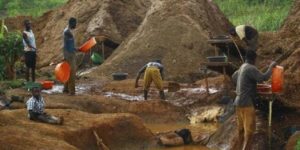
Gold extraction in the region has historically included artisanal and semi-mechanized operations.
Recent government activity demonstrates that Batouri remains strategically relevant.
In June 2026, a government-led inspection mission visited a gold production site in Batouri to examine production and assess compliance with applicable mining-related fiscal requirements.
The wider geological importance of Batouri is also reflected in continuing scientific research. A 2026 study investigated structural controls on gold mineralization in the Batouri area, including faults, shear zones, altered quartz veins and alluvial environments.
For investors, this illustrates an important point:
Cameroon’s gold potential is not based only on historical production. Geological exploration and evaluation are continuing.
Bipindi-Lolodorf and Southern Cameroon
Southern Cameroon also has important gold occurrences and exploration potential.
The Bipindi-Lolodorf area has been studied through geological mapping, geochemistry, geophysics and structural analysis.
Research has identified gold-bearing quartz veins and geological structures that may control mineralization in parts of the area.
More recent research around Bipindi has used:
- Stream-sediment geochemistry
- Petrography
- Sedimentology
- Geostatistical analysis
- Mineralogical investigation
The 2026 study found gold anomalies in sampled sediments but cautioned that the results represented a local alluvial anomaly rather than proof of substantial mineralization, recommending further sampling and mineralogical work.
This is exactly the type of distinction serious investors should understand.
Exploration results can identify areas worthy of further investigation without proving that a commercially viable mine exists.
Cameroon’s Gold Industry Is Moving Toward Greater Formalization
One of the most significant developments in Cameroon is not simply the discovery of additional gold occurrences.
It is the government’s effort to improve how the gold industry is organized.
In July 2026, Cameroon’s Ministry of Mines, Industry and Technological Development (MINMIDT), together with the Ministry of Communication, presented reforms under the theme of transforming the mining sector and restructuring the gold industry.
The government highlighted objectives including:
- Industrialization
- Improved traceability
- Better public revenue collection
- Formalization
- Environmental protection
- Increased participation by Cameroonian operators
- Attraction of foreign investment
This represents an important development for international buyers.
A stronger formal mining system can make it easier to distinguish legitimate supply chains from undocumented or illegally produced material.
The Colomine Gold Project Marks an Important Step
Cameroon is also moving toward industrial gold production.
The government identifies the Colomine Gold Project among the country’s major mining projects.
According to MINMIDT’s July 2026 communication, Cameroon entered a new phase of mining development following the commissioning of several major mining projects, including the Colomine gold project.
This is significant because Cameroon’s gold industry has historically been dominated by artisanal and small-scale mining.
Industrial projects can potentially introduce:
- Modern geological exploration
- Mechanized mining
- Professional processing
- Formal employment
- Improved environmental controls
- Greater production transparency
- More reliable production statistics
- Increased government revenue
However, the development of industrial mining does not mean artisanal mining disappears immediately.
Both sectors may continue to operate within the broader mining economy, subject to the country’s regulatory framework.
Why Gold Production Statistics Require Caution
The original version of this article stated that Cameroon produces approximately 10,000 kilograms of gold annually according to the US Geological Survey.
This figure should not be presented as a current official production figure without qualification.
Cameroon’s gold sector has historically faced challenges involving informal production, under-reporting, smuggling and limited traceability.
In July 2026, the Cameroonian government specifically acknowledged problems involving fraud and insufficient traceability in the gold sector, including discrepancies between quantities produced, collected and exported.
This means that different estimates can represent very different things:
Estimated geological potential ≠ artisanal production ≠ officially collected gold ≠ officially exported gold.
For international buyers, this distinction is critical.
Why Traceability Is Becoming More Important
A growing gold market requires more than increased production.
It requires confidence in the supply chain.
Traceability helps answer questions such as:
- Where did the gold originate?
- Who produced it?
- Who purchased it?
- How was it processed?
- Who transported it?
- Was it legally exported?
- What quantity was produced?
- What quantity entered the formal market?
Cameroon’s government has recently emphasized strengthening traceability as part of its gold-sector reforms.
This is particularly relevant to international buyers purchasing gold from Cameroon.
A buyer should not evaluate a transaction solely by looking at the stated purity or price.
The origin and documentation of the gold matter as well.
What Does Cameroon’s Mining Authority Do?
The Ministry of Mines, Industry and Technological Development (MINMIDT) is the principal government ministry responsible for Cameroon’s mining sector.
For current regulatory information, buyers should use the official MINMIDT website rather than unofficial websites offering mining permits, export documents or government certificates.
MINMIDT – Official Cameroon Ministry of Mines
MINMIDT publishes information concerning mining legislation, sector developments and government programs.
The ministry also provides access to Cameroon’s mining legislation, including the 2023 Mining Code.
For a buyer, these official sources are more reliable than social-media advertisements or third-party websites claiming to represent Cameroon’s mining authorities.
What Does the Growth of Industrial Mining Mean for International Buyers?
The development of industrial mining could create several opportunities for the international gold market.
1. Greater Production Capacity
Industrial operations can potentially produce gold at a larger and more consistent scale than individual artisanal operations.
2. Improved Documentation
Formal mining operations generally have more structured production, accounting and regulatory systems.
3. Better Traceability
Formalization can improve the ability to document the movement of minerals from production through processing and export.
4. Investment Opportunities
As exploration and industrial projects expand, opportunities may arise in:
- Mining
- Processing
- Refining
- Logistics
- Equipment
- Geological services
- Environmental services
- Mining technology
5. Economic Development
Mining can contribute through:
- Employment
- Government revenue
- Infrastructure
- Local procurement
- Foreign investment
- Technology transfer
However, these benefits depend on effective regulation and responsible project development.
Cameroon Gold and the Importance of Responsible Mining
Increasing gold production should not be viewed only through the lens of volume.
Responsible mining also requires attention to:
- Environmental impacts
- Worker safety
- Community relations
- Land use
- Water management
- Rehabilitation
- Legal compliance
- Supply-chain transparency
The long-term success of Cameroon’s mining industry will depend not only on how much gold is produced, but also on how responsibly that gold is produced and brought to market.
What Should International Gold Buyers Look For?
International buyers considering Cameroon-origin gold should conduct due diligence before entering a transaction.
At a minimum, buyers should examine:
Company identity
Verify who the seller is and whether the company can be independently identified.
Legal authority
Determine whether the seller has the legal authority to produce, purchase or sell the material.
Origin
Ask where the gold originated and request supporting documentation.
Assay
Establish the stated purity and determine how the assay was conducted.
Chain of custody
Understand how the gold moved from its source to the seller.
Government documentation
Verify applicable permits, certificates and export requirements with the competent authorities.
Independent testing
For significant transactions, arrange appropriate independent testing or assay.
Payment structure
Use a written agreement that clearly defines:
- Quantity
- Purity
- Price
- Assay procedure
- Delivery
- Payment terms
- Responsibilities of each party
These precautions are especially important in cross-border gold transactions.
Cameroon Gold for International Markets
Cameroon has the geological potential, existing gold-producing regions and emerging industrial projects necessary to become a more important participant in Africa’s formal gold industry.
However, the country’s future position in the global gold market will depend on more than geological resources.
It will depend on the ability to:
Explore → Develop → Produce → Formalize → Trace → Process → Export responsibly.
The government’s current mining reforms indicate that this transition is already underway.
For international buyers, this creates an opportunity—but also a responsibility.
The strongest gold supply chains will be those that can demonstrate not only the quality of the gold but also its legal origin, documented chain of custody and compliance with applicable regulations.
Bonas Gold and Cameroon’s Gold Supply Chain
As a Cameroon-based gold company, Bonas Gold operates within this broader mining and gold-trading environment.
Our website provides information about our gold-related activities, including:
- Gold Dore Bars from Cameroon
- Gold Dust from Cameroon
- Gold Nuggets from Cameroon
- Refined Gold Bars from Cameroon
- Gold Mining, Refining and Trading Services
- Gold Order Process from Cameroon
- Bonas Gold Documents
Buyers should still conduct their own independent due diligence and verify applicable government requirements before entering a significant transaction.
Cameroon’s Gold Industry Is Entering a New Phase
Cameroon has substantial gold potential, but the country’s mining story is evolving.
Areas such as Batouri, Bétaré-Oya, Bipindi-Lolodorf, Sangmelima, Ebolowa, Mamfe and Misaje demonstrate the geographical breadth of reported gold occurrences and exploration targets.
At the same time, projects such as Colomine demonstrate the country’s movement toward industrial mining. Recent government reforms are placing greater emphasis on formalization, traceability, investment, environmental responsibility and increased economic benefits from mineral resources.
For investors and international gold buyers, the opportunity should therefore be evaluated carefully.
Cameroon has gold. The next question is how effectively, transparently and responsibly that gold can be developed and brought into formal international markets.