History of Gold Mining in Cameroon: From Colonial Production to Modern Industrial Mining
Cameroon has a long history of gold mining that predates the country’s modern mining industry.
Gold extraction developed during the colonial period, expanded through artisanal and small-scale mining after independence, and has more recently entered a new phase focused on formalization, traceability and industrial-scale projects.
Today, understanding the history of Cameroon’s gold sector is important for anyone interested in the country’s mining industry, mineral investment, responsible sourcing or the development of formal gold supply chains.
The story can broadly be understood through four stages:
Colonial-era gold mining → Post-independence artisanal mining → Formalization and sector restructuring → Emerging industrial gold production
When Did Gold Mining Begin in Cameroon?
Gold mining in Cameroon is generally traced to the colonial period, with gold exploitation documented from the early twentieth century.
Historical accounts commonly place the development of organized gold mining around the 1930s, particularly during the colonial administration.
Gold-producing areas in the eastern and southern parts of the country attracted attention because of their alluvial and hard-rock gold occurrences.
During this period, mining was considerably different from today’s industrial mining model.
Production relied heavily on manual labor and relatively simple extraction techniques, while the infrastructure, geological knowledge and processing technology available to operators were much more limited than those used by modern mining companies.
Some historical accounts describe the 1940s as an important period for Cameroon’s gold industry and report very high estimates of gold’s contribution to the economy.
However, these historical figures should be treated carefully.
The frequently repeated claim that gold represented approximately 20% of Cameroon’s GDP during the 1940s is not sufficiently supported by the current primary sources available from Cameroon’s mining authorities and should not be presented as an established statistic without a specific historical source.
For an authoritative modern article, it is more accurate to say that gold mining was an important colonial economic activity and that production subsequently declined in importance relative to other sectors.
Gold Mining After Cameroon’s Independence
Following independence, Cameroon’s mining sector entered a different phase.
Large-scale commercial gold production did not develop to the extent seen in some other African gold-producing countries.
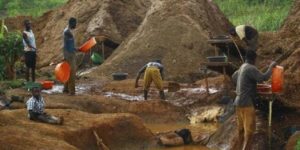
Instead, gold extraction increasingly became concentrated in artisanal and small-scale mining.
This was particularly important in areas of the Eastern Region, including:
- Bétaré-Oya
- Batouri
- Ketté
- Ngoura
- Other gold-bearing localities
Gold was recovered from alluvial deposits and, in some areas, from primary mineralized zones.
Because many operations were small and dispersed, production was difficult to measure precisely.
This is one of the reasons historical estimates of Cameroon’s gold production can vary substantially depending on whether they refer to recorded production, estimated artisanal output or broader estimates of gold leaving production areas.
The Rise of Artisanal and Small-Scale Gold Mining
For decades, artisanal and small-scale mining became the dominant form of gold production in Cameroon.
The sector provided income and employment for communities in gold-producing regions, particularly where alternative economic opportunities were limited.