Cameroon Gold Belt: Northern Cameroon Geology, Rey Bouba and Alluvial Gold Potential
Cameroon’s gold potential is closely connected to the country’s complex Precambrian geology and its position within the Central African Pan-African orogenic system. Northern Cameroon is particularly important from a geological perspective because it contains ancient volcanic, sedimentary, metamorphic, and magmatic rocks associated with Neoproterozoic tectonic activity.
One of the geological units attracting attention is the Rey Bouba Greenstone Belt, located in north-central Cameroon. Geological research indicates that the belt contains metavolcanic and metasedimentary rocks formed within a continental-arc environment during the Neoproterozoic. These geological characteristics help explain why northern Cameroon has continued to attract interest in gold exploration.
Gondwana and the Pan-African Geological History
The geological history of northern Cameroon cannot be separated from the formation and later assembly of Gondwana.
During the Neoproterozoic, major continental blocks converged and interacted through subduction, accretion, deformation, metamorphism, and magmatic activity. These processes formed the broader Pan-African orogenic system, which extends across parts of Central and West Africa.
In Cameroon, the Pan-African geological framework includes several domains, greenstone belts, granitoid complexes, and major structural zones. Northern Cameroon records particularly important evidence of this geological evolution. Recent research continues to refine the relationships between magmatic arcs, greenstone belts, shear zones, and later post-collisional magmatism in the region.
The Rey Bouba Greenstone Belt
The Rey Bouba Greenstone Belt (RBGB) is one of the important volcano-sedimentary belts of northern Cameroon.
Research published in Precambrian Research describes the Rey Bouba belt as a low- to medium-grade metamorphic belt situated along the northern margin of the Central African Fold Belt. Geochemical and geochronological evidence indicates that its volcanic rocks have characteristics consistent with a continental-arc environment associated with subduction.
The research places the maximum age of volcanic activity at approximately 670 million years, while the maximum depositional age of associated metasedimentary rocks is constrained to approximately 645–630 million years. Evidence for low-grade metamorphism is associated with an age of roughly 600 million years.
These dates are important because they show that the rocks hosting or associated with prospective mineral systems in northern Cameroon are products of very old geological processes rather than recent formations.
Mayo-Kebbi and Northern Cameroon’s Geological Architecture
Another important geological component is the Mayo-Kebbi magmatic arc and associated basement rocks.
The Mayo-Kebbi domain extends across northern Cameroon and into Chad and contains greenstone belts, magmatic complexes, batholiths, and other components of Neoproterozoic crust. Geological studies interpret the area as part of a magmatic-arc system that developed during the broader Pan-African geological evolution of the region.
The relationship between these geological units is relevant to mineral exploration because gold deposits are often controlled by particular combinations of lithology, deformation, hydrothermal alteration, structures, and the geological history of the host rocks.
However, geological prospectivity should not be confused with a proven commercial reserve. A geological belt can indicate favorable exploration conditions without establishing the quantity, grade, economic viability, or mineability of a specific gold deposit.
Evidence From River Alluvium
One study of northern Cameroon examined heavy minerals contained in river alluvium.
The researchers compared the heavy-mineral assemblages found in river sediments with the surrounding basement rocks. Their results were consistent with contributions from rocks associated with the Mayo-Kebbi magmatic arc and Rey Bouba Greenstone Belt.
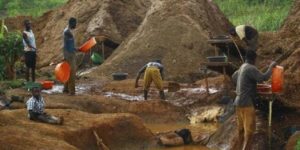
Importantly, the study reported natural gold within the alluvial material and suggested that the gold could have originated from the Rey Bouba Greenstone Belt. The authors concluded that the findings provided an indication of potential for further investigation of alluvial gold in northern Cameroon.
This distinction matters for international buyers and investors: the study identifies a geological exploration opportunity, not a certified resource estimate or guarantee of commercially recoverable gold.
Why Alluvial Gold Is Important in Cameroon
Alluvial gold occurs in unconsolidated sediments deposited by rivers and streams. Because gold is dense and resistant to weathering, particles released from mineralized rocks can be transported by water and concentrated in suitable sedimentary environments.
This makes river sediments useful during early-stage mineral exploration.
Geologists can investigate:
- Gold grains in river sediments
- Heavy-mineral assemblages
- Upstream geological formations
- Faults and shear zones
- Quartz veins and alteration zones
- Geochemical anomalies
- Host-rock characteristics
- Gold grain morphology and provenance
Anomalies identified in stream sediments can then guide more detailed field investigation.
For commercial mining, however, additional work is normally required. Exploration may progress from regional reconnaissance to systematic sampling, geological mapping, geochemical surveys, geophysics, drilling, resource estimation, metallurgical testing, and eventually economic evaluation.
Northern Cameroon and the Bibemi Goldfield
Northern Cameroon is not only of historical geological interest. Modern research has also examined active gold exploration areas such as the Bibemi goldfield.
A geological and remote-sensing study of the Bibemi area describes the region as part of the northwestern Cameroonian domain and identifies a geological setting containing Neoproterozoic schists and gneisses, Pan-African granitoids, and volcanic and sedimentary formations.
This demonstrates why northern Cameroon remains relevant to modern gold exploration: ancient geological structures provide the framework, while modern exploration techniques allow researchers and mining companies to investigate specific mineralized zones.
What the Geology Means for Gold Buyers
For an international buyer, geological information is useful because it helps establish where gold originates and why certain regions may be prospective.
But geology is only one component of a legitimate gold transaction.
A professional buyer should also consider:
- Origin documentation – Where was the gold produced or legally sourced?
- Mining authorization – Was the material produced under an appropriate legal framework?
- Assay results – What is the verified gold content?
- Chain of custody – Can the material be followed through the supply chain?
- Export documentation – Has the required legal export process been completed?
- Seller identity – Can the company and its representatives be independently verified?
- Commercial terms – Are the quantity, purity, price, delivery terms, and payment conditions clearly documented?
- Independent verification – Can the buyer arrange appropriate inspection, sampling, or assay before final settlement?
These checks are particularly important when purchasing gold internationally because geological potential does not by itself establish the authenticity or legality of a particular shipment.
Cameroon’s Gold Potential Requires Exploration and Verification
Cameroon should not be described simply as a single continuous “gold belt.” Its gold potential is distributed across different geological environments and regions, each with its own exploration history, mineralization characteristics, and level of geological knowledge.
Northern Cameroon is nevertheless an important area of geological research. The Rey Bouba Greenstone Belt, Mayo-Kebbi magmatic systems, Bibemi area, and associated structural zones provide evidence of a complex geological history capable of supporting continued mineral exploration.
Research on the Rey Bouba Greenstone Belt provides evidence for Neoproterozoic continental-arc processes, while heavy-mineral studies of northern river sediments have identified natural gold and suggested possible links to nearby geological units.
For the mining industry, the next question is not simply whether gold exists. The critical questions are where it occurs, at what grade, in what geological form, at what scale, and whether it can be developed legally, economically, and responsibly.